
As solar panel waste streams become more diverse, recycling facilities increasingly face a practical question: can a single recycling line efficiently process both single-glass and double-glass photovoltaic (PV) modules? The answer depends on equipment design, process integration, and operational flexibility. With the right engineering approach, one well-configured system can handle both types while maintaining stable output and recovery efficiency. At YUSHUNXIN, we manufacture solar panel recycling equipment specifically designed to adapt to varying panel structures and real-world processing conditions.
Understanding the Structural Differences
Single-glass panels typically consist of a front glass layer, EVA encapsulation, solar cells, and a polymer backsheet. In contrast, double-glass modules replace the backsheet with an additional glass layer, resulting in a heavier and more rigid structure. For facilities handling significant volumes of newer panel designs, a dedicated double-glass module processing solution can be integrated into a mixed-waste line.
These differences affect how panels respond to dismantling and crushing. Double-glass panels require stronger mechanical handling and more controlled processing to ensure effective material separation without excessive loss or equipment strain.
The Role of Front-End Processing
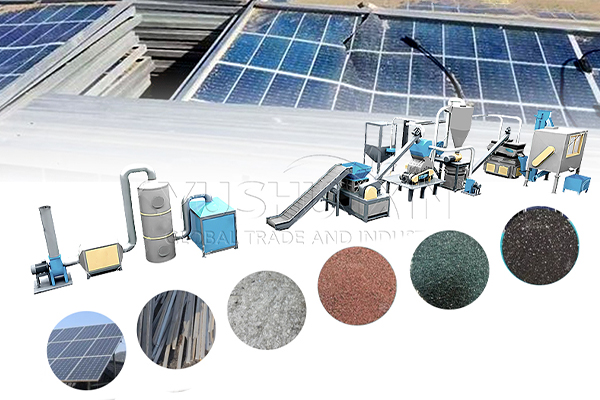
Efficient processing of mixed panel types begins at the front end. YUSHUNXIN recycling systems use dedicated frame removal machines to separate aluminum frames, followed by glass removal machines to detach major glass layers before crushing.
This staged approach reduces the load on downstream equipment and allows both single and double-glass panels to enter the crushing phase in a more uniform condition. Proper front-end processing is critical for maintaining system stability when handling mixed inputs.
Adaptive Crushing and Separation Systems
A key requirement for handling both panel types is a crushing system capable of adjusting to different material strengths and thicknesses. YUSHUNXIN equipment applies controlled crushing force to ensure effective size reduction for both lighter single-glass panels and more robust double-glass modules.
Following crushing, integrated separation systems—such as screening and airflow sorting—are used to recover glass, metals, and silicon-containing materials. Consistent separation performance ensures that mixed inputs do not compromise output quality. Advanced techniques like copper recovery from waste panels demonstrate the value of precise material sorting.
Operational Flexibility and Efficiency
A single recycling line designed for mixed panel processing offers clear operational advantages. It eliminates the need for separate lines, reduces capital investment, and simplifies plant layout. However, this requires careful system design to avoid inefficiencies or equipment overload.
YUSHUNXIN solar panel recycling equipment is engineered with modular configurations and durable components, allowing operators to adjust processing parameters based on input material characteristics. This flexibility supports stable throughput and efficient material recovery.
A Practical Solution for Mixed PV Waste
Handling both single and double-glass panels in one system is not only possible—it is increasingly necessary as recycling volumes grow. The key lies in using equipment designed for adaptability and consistent performance. The PV recycling operations in India demonstrates how mixed-waste lines can be configured to meet diverse processing requirements in emerging markets.
As a manufacturer of solar panel recycling equipment, YUSHUNXIN focuses on delivering integrated solutions that meet diverse processing needs. With the right system design, recycling facilities can efficiently process mixed PV waste streams while maintaining high recovery rates and long-term operational stability.
Leave a Reply