
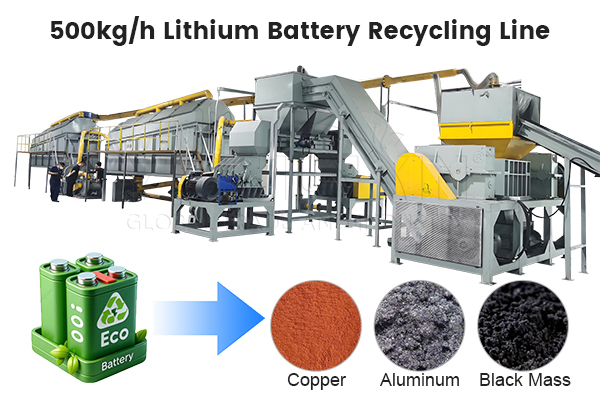
The cost of a lithium battery recycling line usually depends on capacity, automation level, battery type and final product requirements. For a small or medium mechanical recycling line, buyers may see reference ranges from about $50,000–$100,000 for 300–500 kg/h and $100,000–$300,000 for 500–800 kg/h configurations. Larger industrial projects with automatic discharge, shredding, separation, dust control and advanced safety systems can cost more.
However, the cheapest line is not always the best choice. A profitable lithium battery recycling project should focus on stable feeding, safe discharge, high black mass recovery and clean separation of copper, aluminum and casing materials.
Why Does Battery Discharge Affect the Total Cost?
Battery discharge is the first key step before crushing. Waste lithium batteries may still carry residual electricity. If batteries enter shredding equipment without proper discharge, the line may face fire, smoke or explosion risks.
Therefore, a complete lithium battery recycling line often includes a discharge system, drying section or safety treatment before mechanical crushing. This part increases the initial investment, but it protects the crusher, workers and the whole plant. For EV batteries, module packs or mixed battery waste, the discharge and pretreatment cost can be higher.
What Equipment Is Included Before Black Mass Separation?
A standard mechanical lithium battery recycling line usually includes battery discharge, feeding conveyor, primary shredder, crusher, grinder, air separation, magnetic separation, vibrating screen, pulse dust collector and control cabinet. Some projects also need inert gas protection, fire control, negative-pressure dust collection and waste gas purification.
The main goal is to separate valuable black mass from metal fractions. Black mass contains cathode and anode powder, while copper, aluminum and steel need separate collection. Research on spent lithium-ion battery recycling also highlights discharge, sorting, crushing, sieving and physical separation as key pretreatment steps before deeper material recovery.
Which Factors Increase Lithium Battery Recycling Line Price?
Capacity is the first factor. A 500 kg/h line needs stronger crushing, screening and dust collection than a small pilot line. Battery type also matters. Soft-pack batteries, cylindrical cells, pouch cells, mobile phone batteries and EV modules require different feeding and pretreatment designs.
Automation level also changes the price. Manual feeding reduces initial cost, but automatic feeding, PLC control, continuous separation and online dust control reduce labor and improve stability. Environmental configuration is another important cost point, especially for projects in Europe, North America, the Middle East and regulated industrial parks.
How Should Investors Plan the Budget?
Investors should not only ask for the lithium battery recycling machine price. They should calculate the full project cost, including equipment, installation, power supply, workshop area, safety system, dust collection, waste gas treatment, spare parts and operator training.
If your target is black mass recovery, the line should protect powder purity and reduce metal contamination. If your target is copper and aluminum recovery, the separation accuracy becomes more important. Yushunxin can design a suitable lithium battery recycling line according to your battery type, capacity target, site layout and final product requirement. Visiting: https://www.sxlbp.com/products/lithium-battery-recycling-machine-cost/
Leave a Reply