
When buyers evaluate a 500kg/h lithium battery recycling machine, the quoted price is not determined by capacity alone. It also depends on the battery type, process configuration, automation level, safety design, separation target, and supporting systems. As a manufacturer of lithium battery recycling equipment, YUSHUNXIN helps customers compare these factors clearly, so they can choose a solution that matches their production needs instead of paying for an unsuitable setup.
1. Battery Type and Raw Material Condition
The first factor is the type of waste battery to be processed. A line designed for lithium-ion battery cells, battery packs, black mass materials, or mixed battery scraps may require different feeding, shredding, and separation equipment. Raw materials with high moisture, irregular size, or complex pack structures can also increase the need for pretreatment systems. The more difficult the material is to handle, the more demanding the machine configuration becomes. Understanding which battery recycling method suits your feedstock helps you avoid unnecessary upfront costs.
2. Process Configuration of the Recycling Line
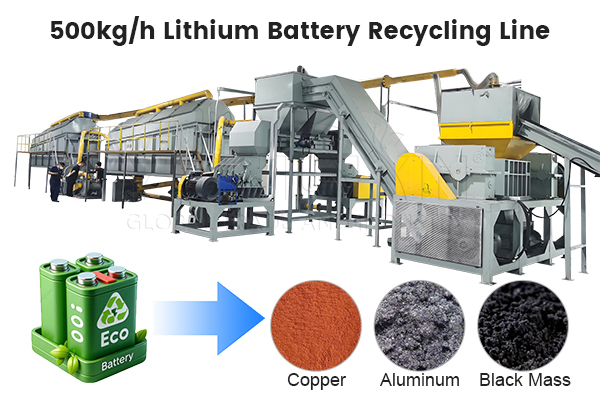
A 500kg/h lithium battery recycling system may include discharging, dismantling, crushing, pyrolysis or drying, magnetic separation, screening, air separation, and dust collection, depending on the project requirement. A basic mechanical separation line and a more complete recovery-oriented line will not have the same investment level. Customers who aim to obtain cleaner copper, aluminum, and black mass fractions usually need a more refined process design. Reviewing typical materials recovered from battery recycling can clarify which process features are essential for your target outputs.
3. Automation Level and Labor Requirement
Automation has a direct influence on the machine price. A semi-automatic system may reduce initial cost, while a higher-automation line can improve continuous operation, reduce manual intervention, and support more stable production. For customers with limited labor resources or higher requirements for production consistency, the automation level becomes an important consideration.
4. Safety and Environmental Protection Systems
Lithium battery recycling involves risks such as residual energy, dust, and volatile substances. Therefore, safety-related configurations cannot be ignored. Systems such as sealed conveying, temperature monitoring, explosion prevention design, dust removal, and gas treatment may affect the final quotation. These features are not simply optional extras; they are closely related to long-term operating stability and workplace safety.
5. Equipment Materials, Durability, and Service Scope
Machine structure, wear-resistant parts, motor selection, control system quality, and overall service package also influence the price. A lower initial quote does not always mean lower long-term cost. Buyers should compare machine durability, maintenance convenience, installation support, and spare parts service together. For a realistic look at upfront investment, current pricing for lithium battery recycling equipment varies across configuration levels, so comparing specs side by side is essential.
How YUSHUNXIN Helps Customers Choose
At YUSHUNXIN, we recommend evaluating a 500kg/h lithium battery recycling machine according to actual raw materials, final recovery goals, workshop conditions, and investment plan. Instead of offering one fixed model for every buyer, we provide tailored equipment configurations to help customers build a more practical and cost-effective recycling solution. For those planning to scale up later, a complete 500kg per hour recycling plant provides a clear reference point for both specifications and budget. Visiting: https://www.greenindustrialsolutionsx.com/product/1000kg-h-lithium-battery-disposal-line/
Leave a Reply