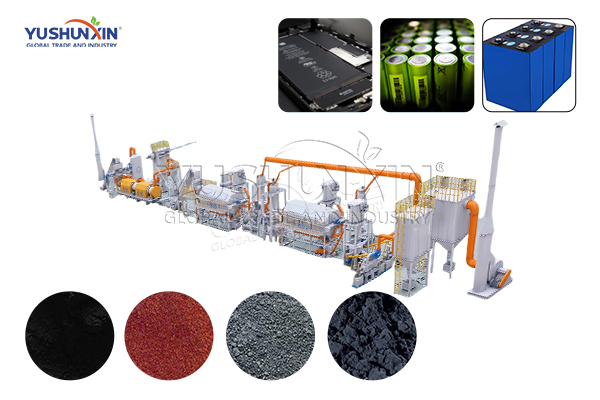
Category: lithium battery recycling

How do you compare supplier bids for a lithium battery recycling plant?
Suppliers of battery recycling equipment describe their offers in different ways, so a fair comparison needs one scope, one unit of capacity and one acceptance test, and you, as a recycling company owner or as a project investor, define those three elements before the tender. A hydrometallurgical lithium battery recycling package includes pretreatment, chemical recovery…
Which processing capacity makes a lithium battery recycling plant suitable for a regional waste treatment programme?
Regional plans set collection targets for batteries, and those targets become realistic only when a treatment facility exists inside the region, so you, as a municipal programme manager or as a recycling investor, match the processing capacity to the volume that the plan actually collects. The lithium battery recycling equipment investment follows that capacity decision,…
What ROI can project investors expect from a lithium battery recycling plant?
Investors ask one question about a battery plant, which is how quickly the project returns the capital, and you, as a project investor or as a recycling company manager, answer that question with a model that separates the equipment price from the operating result. The lithium battery recycling line price covers the discharge station, the…
1000kg/h Lithium Battery Recycling Plant Layout: Power, Space and Equipment Configuration
Building a 1000kg/h lithium battery recycling plant involves much more than selecting a shredder. A successful project depends on balancing equipment configuration, electrical power, workshop space, and material flow. Poor layout planning can reduce production efficiency, increase labor costs, and make future expansion difficult. Whether you are planning a new recycling facility or upgrading an…
Black Mass Recovery for EV Battery Recycling Companies
As the global electric vehicle market continues to expand, millions of lithium-ion batteries will reach end-of-life in the coming years. For EV battery recycling companies, black mass recovery has become one of the most valuable stages in the recycling process. Rather than focusing only on waste disposal, modern recyclers are increasingly looking at black mass…
How to Separate Black Mass from Lithium Batteries Efficiently?
Black mass separation is one of the most important steps in lithium battery recycling. After waste lithium batteries are discharged, dismantled, shredded and separated, the valuable electrode powder can be collected as black mass. This material usually contains lithium, nickel, cobalt, manganese, graphite and other active materials. For recycling companies, efficient black mass separation is…
500kg/h vs 1000kg/h Lithium Battery Recycling Line: Which Capacity Fits Your Project?
Choosing the right lithium battery recycling line is not only about buying a larger machine. It is about matching your raw material volume, workshop space, investment plan, recovery target, and long-term business growth. For many recycling investors, the key question is simple: should you start with a 500kg/h lithium battery recycling plant or move directly…
What Factors Affect the Price of a 500kg/h Lithium Battery Recycling Machine?
When buyers evaluate a 500kg/h lithium battery recycling machine, the quoted price is not determined by capacity alone. It also depends on the battery type, process configuration, automation level, safety design, separation target, and supporting systems. As a manufacturer of lithium battery recycling equipment, YUSHUNXIN helps customers compare these factors clearly, so they can choose…