
A lithium battery recycling project shows two cost pictures: the investment that the owner pays once and the operating cost that the plant carries every month, and you, as a project investor or as a recycling company manager, need both before the board approves the budget. The lithium battery recycling plant operating cost covers labour, energy, consumables, maintenance and the logistics of collecting packs. The lithium battery recycling plant operating cost also determines the break even tonnage, and that tonnage decides whether the project needs one shift or two.
Which cost groups form the total estimate?
The equipment group covers the discharge station, the shredder, the hammer mill, the dryer, the separators and the dust collector. The civil group covers foundations, the process hall, the storage area and the utility connections. The permit group covers the environmental assessment and the hazardous material registration. The working capital group covers the first months of scrap purchase and the salaries of the operating team before the first invoice arrives, and that group is often underestimated in early estimates.
Which operating items change the monthly cost most?
Labour depends on the automation level of the line, because a plant with automatic feeding needs fewer operators per shift. Electricity and thermal energy depend on the moisture of the incoming packs and on the drying temperature that the process requires. A battery recycling plant total cost estimate also includes the wear parts of the shredder and the mill, and those parts follow the tonnage that the plant processes. Your maintenance plan converts those consumption figures into an annual spare parts budget.
How does the equipment configuration change the cost structure?
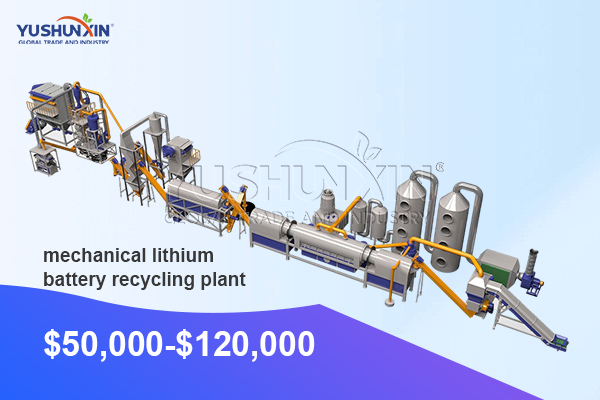
A mechanical line with crushing, drying and separation recovers copper, aluminium and black mass, and that configuration keeps the investment inside a moderate range. A hydrometallurgical extension adds reactors, reagents and wastewater treatment, and that extension raises both capital and operating cost. The lithium battery recycling machine configuration that your engineers select therefore decides the cost per processed tonne. Your team compares the two routes with the same input material, and that comparison shows which route matches the local market for recovered material.
How do you build the cost model that lenders read?
The model starts with a collection forecast, because the contracted volume fixes the utilisation rate of the line. Your finance team adds the tonnage dependent costs, the fixed monthly costs and the revenue from copper, aluminium, lithium carbonate and black mass. A lithium battery recycling project budget planning sheet then tests three price scenarios, and those scenarios show the range of the debt service capacity. The sensitivity table becomes the core of the investment memorandum.
Conclusion for project investors and recycling companies
A reliable cost estimate separates one time investment from recurring cost, and that separation keeps the budget realistic through the first operating year. A battery recycling plant construction partner that provides capacity data, layout drawings and commissioning support strengthens the technical annex of the loan file. Battery material recovery also returns critical metals to the supply chain, and that circular result supports green finance applications. If your team needs a reference for the cost structure of a new line, you can learn more about https://www.sxlbp.com/products/lithium-battery-recycling-machine-cost/ before the next credit committee meeting.