
If you’re planning a 500kg/h operation, you’re likely past the pilot stage—or you’re starting at a scale that actually makes sense for 2026. But before you price out shredders or sign a lease, two numbers will make or break your project: square meters and kilowatts. Get either wrong, and your “profitable plant” becomes an idle machine eating floor space. As a manufacturer who has installed over 60 lithium battery recycling lines worldwide, we’ll give you the real-world requirements—no architectural fluff, just what works.
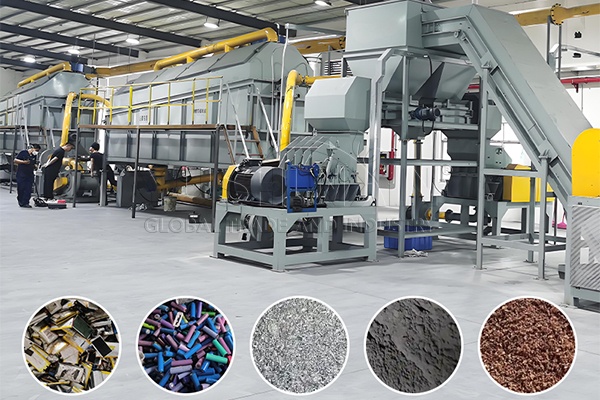
Space Requirements: Indoors, Safe, and Efficient
A complete 500kg/h line—including primary shredder, fine crusher, air gravity separator, magnetic separation, dust collection system, and control cabinet—requires approximately 120–180 square meters (1,300–1,950 sq ft) of dedicated indoor space. Why indoors? Dust control, fire safety, and noise regulation. You’ll also need an additional 30–40 sq m for raw battery storage (fire-rated) and another 20 sq m for black mass and copper/aluminum outputs.
Layout matters more than size. Our compact skid-mounted design fits into 150 sq m with maintenance aisles. Ceiling height should be at least 4.5 meters to accommodate the gravity separator and ductwork. We’ve seen customers squeeze into 100 sq m—but that kills airflow and operator safety. Don’t. For a clearer picture of what a complete setup looks like, you can review a typical 500kg per hour battery recycling facility layout before finalizing your floor plan.
Power Requirements: Real Draw, Not Nameplate
Here’s where buyers get surprised. A 500kg/h plant has an installed motor total of roughly 180–220 kW, but actual operating draw is 110–140 kW because not all motors run at full load simultaneously. You’ll need a 400V, three-phase, 50/60 Hz supply with a 250A main breaker. Critical: your local grid must handle startup surges—especially the primary shredder (peaks at 90 kW for 3–5 seconds).
We provide soft starters on all our systems to cut inrush current by 60%. Without them, you’ll trip breakers daily. Also factor 15–20 kW for auxiliary systems (lights, ventilation, baling press). Total monthly consumption at 16 hours/day, 25 days/month: roughly 55,000–70,000 kWh. Understanding what metals can be recovered from recycled batteries helps you calculate the value offset for your power investment.
The Bottom Line for Your Site Plan
You need a minimum 200 sq m warehouse (including storage) with 140 kW continuous power and 400V three-phase. If your facility has less, you’ll face costly retrofits. If you have more, you can scale to 1000kg/h later. For those handling large volumes of end-of-life automotive packs, exploring complete turnkey EV battery recycling solutions can provide a clearer roadmap for future expansion.
Want our site layout checklist or help calculating your transformer size? Contact us. We don’t sell dreams—we sell machines that fit your actual floor and fuse box. Visiting: https://www.greenindustrialsolutionsx.com/lithium-battery-disposal-in-france/
Leave a Reply